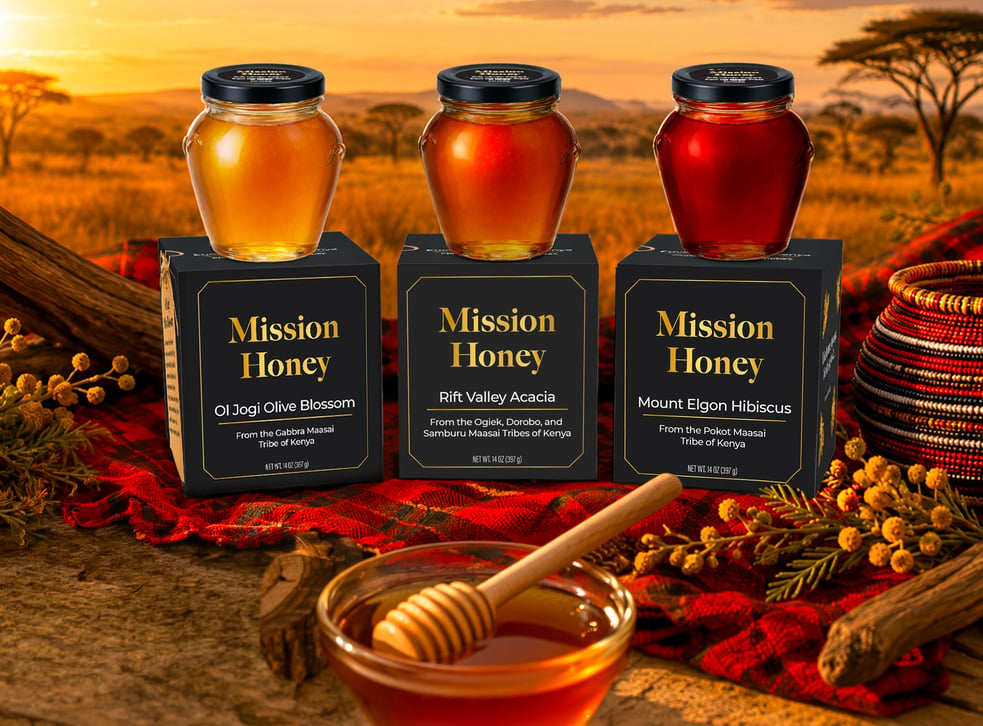
The honey has arrived, and you have until July 18 to reserve a jar from our first batch! Thanks to your support, we were able to purchase thousands of liters of honey from Maasai tribes in Kenya that you are now able to enjoy. Shipping of reserved orders have begun this week, and our store at www.MissionHoney.org will launch shortly.
With our purchase from the tribes, they now have the money to send their kids to school. With your donation today, we will be able to invest further in the Maasai tribes by sending local missionaries iBIBLE episodes in their own languages on solar-powered tablet kits. Check out the FAQs below to learn more.
Make a generous donation through July 18 to reserve your jar today and help us continue to make an impact on Maasai tribes through Mission Honey.Then you can taste and see for yourself what the Lord is doing among the Maasai and how honey can transform lives!
Donate to Help the Maasai Tribes and Reserve Your Jar by July 18
All donations will be used to invest in Mission Honey’s impact on the Maasai tribes’ education and spiritual growth. When you donate by July 18, we will also send you a 14-ouncejar of honeyfrom the very first collection.
The offer of a complimentary honey jar is available only in the US, but we still welcome international donations to help the Maasai.
*All donations are tax deductible to the extent provided by law.
Help Fulfill the Great Commission with the Maasai Tribes
Every Donation Until July 18 Reserves One Jar of Honey!
Loading...
Frequently Asked Questions
We are so thankful for the many questions and concerns we have received about our Maasai honey partnership. If you have any questions you don’t see represented here, please email us at info@revelationmedia.com and we’ll do our best to answer them!
The honey is collected from Maasai tribal communities all over Kenya. Currently, this includes the Gabbra, Pokot, Ogiek, Samburu, and Dorobo communities.
The Maasai tribes collect the honey themselves. Most tribes have experienced honey collectors, as they have collected honey for their own use for generations. They hang hollowed-out logs in trees or use handmade wooden hives for the bees to build hives in, and they use dried cow dung in a tin smoker to calm the bees before collection. Honey is usually collected twice each year.
We pay $100 to $125 per 20-liter bucket (about five gallons) of honey upon collection, which is significantly more than local wholesalers pay. We also supply the tribes with the buckets and pay for transportation of the honey to our warehouse.
We completed our first collection of thousands of liters of honey in November 2025. From there, it was transported to our central warehouse in Kenya and approved for shipping by Kenyan authorities. The honey arrived at the RevelationMedia warehouse in Richardson, Texas in late May 2026. Since then, we have been testing and refining our packaging system, training volunteers, and fulfilling our first orders.
We hope to streamline this international process to shorten the amount of time between collection and fulfillment of future honey batches.
Mission Honey's Maasai honey will be available for purchase from RevelationMedia through our online store, www.MissionHoney.org. While the store is not currently live as reserved orders are being fulfilled, we expect to launch shortly for US purchases.
We do not currently have plans to sell honey from the Maasai through other retailers or internationally. Maasai honey is available in individual 14-ounce jars for all three varieties and in a sample pack containing one two-ounce jar of each variety. We may expand to offer bulk or other purchasing options for future honey shipments.
Maasai honey is available in three distinct varieties—Acacia, Olive Blossom, and Hibiscus. If you reserve a jar of honey through this page, you will receive one of these three varieties at random.
The Maasai tribes benefit from the sale of their honey twofold: They are paid immediately upon the collection of their honey, which gives them the funds to send their children to school and to fix their school buildings. Once the honey is sold in the US, RevelationMedia will use a portion of the profits to translate more iBIBLE content into the heart languages of our partner tribes. We will also send iBIBLE tablets with these videos to pastors and missionaries working among the tribes for evangelism and discipleship.
One hundred percent of the profits from Maasai honey sales will go toward RevelationMedia’s ministry. A portion of these profits will be directly reinvested in the Maasai tribes as we translate more iBIBLE content into the Maasai languages and send more solar-powerediBIBLEtablet kits to pastors and missionaries there. The rest will support other aspects ofRevelationMedia’s ministry where it is most needed, such as iBIBLE production.
The honey is collected from the wild without the use of pesticides or other chemicals and only lightly strained. However, it cannot be certified organic in the United States due to USDA regulations.
The Maasai use a “crush and screen” process to separate the honey from the honeycomb. Then, once it has been transported to our warehouse in Kenya, it is filtered to remove impurities and inspected by Kenyan authorities before it is shipped to the US.When it arrives at the RevelationMedia office in Richardson, Texas, it goes through one final stage of straining if the teams sees any remaining impurities.
None of these stages use fine filtering, and the honey is still considered “unfiltered.” As such, it will both look and taste different than the finely filtered honey most Americans are used to.
We want our Maasai honey partnerships to be an integrated part of our larger mission to bring the Gospel to every tribe, people, and nation on the planet. This is the basis for the name “Mission Honey,” as we see our partnership with the Maasai communities as a way to help fulfill the Great Commission.
We believe that by reinvesting funds earned from the sale of Mission Honey into the Maasai tribes’ spiritual and financial growth, this will become a self-sustaining part of RevelationMedia’s ministry. If all goes well with our Maasai partners, we also hope to expand the ministry of Mission Honey to other tribes in Kenya as well as other African countries.
If we find that the honey sales are taking too much time and too many resources away from our core RevelationMedia and iBIBLE ministries, however, we will either stop the program or turn it over to another organization. We don’t want Mission Honey to be a distraction from the mission of RevelationMedia, but rather an enhancement on the path of the Great Commission.